UK-wide research on learning technology design and deployment to inform ALT / Ufi strategy
I had worked as a member of the research team on the AmplifyFE Sector Audit, commissioned by the Ufi as part of its Voctech Trust work and undertaken by ALT in 2020-21. In 2022 I was commissioned by ALT to conduct further research in the role of Lead Researcher. The year-long, UK-wide, webinar and desk-based project sought insights into how we can best develop and deploy learning technology to support vocational adult learners most impacted by the ‘digital divide’.
In the initial 6-month phase ending in August 2022 I carried out 1-1 interviews with key learning technology project management staff, members of design teams and leaders of communities who have developed or leveraged learning technology and digital tools with vocational learners. I also examined vocational learning technology project outputs and reports from successful, established projects. The work was underpinned by references to a range of digital skills frameworks used in developing FE learners’ and teachers’ digital skills.
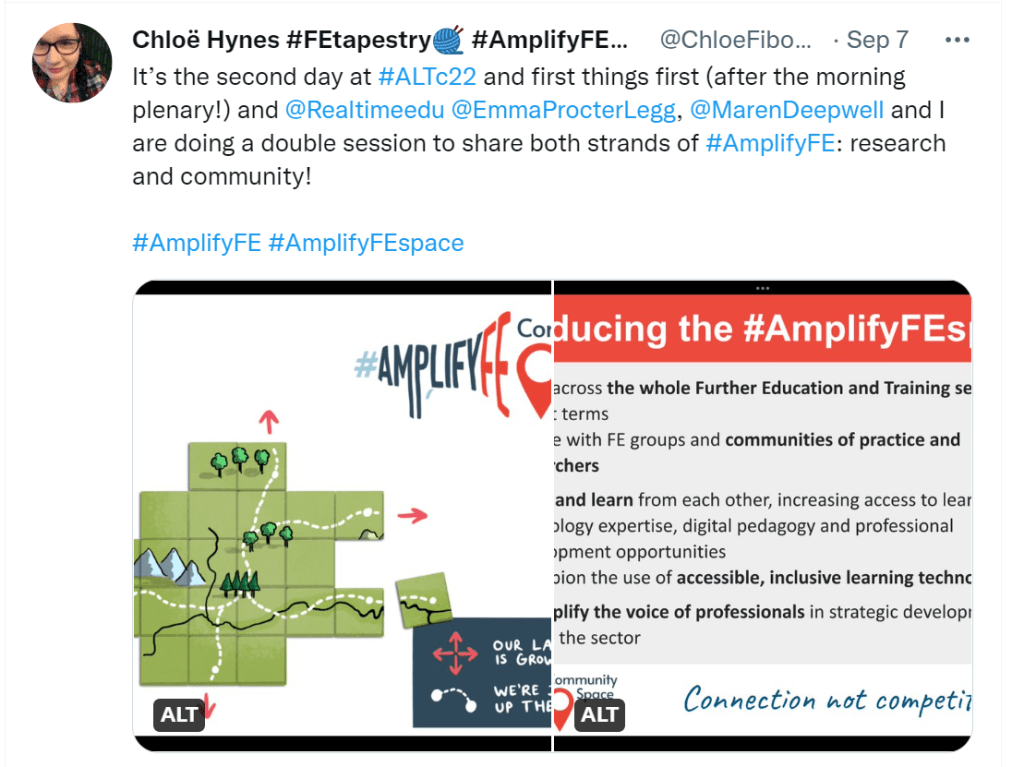
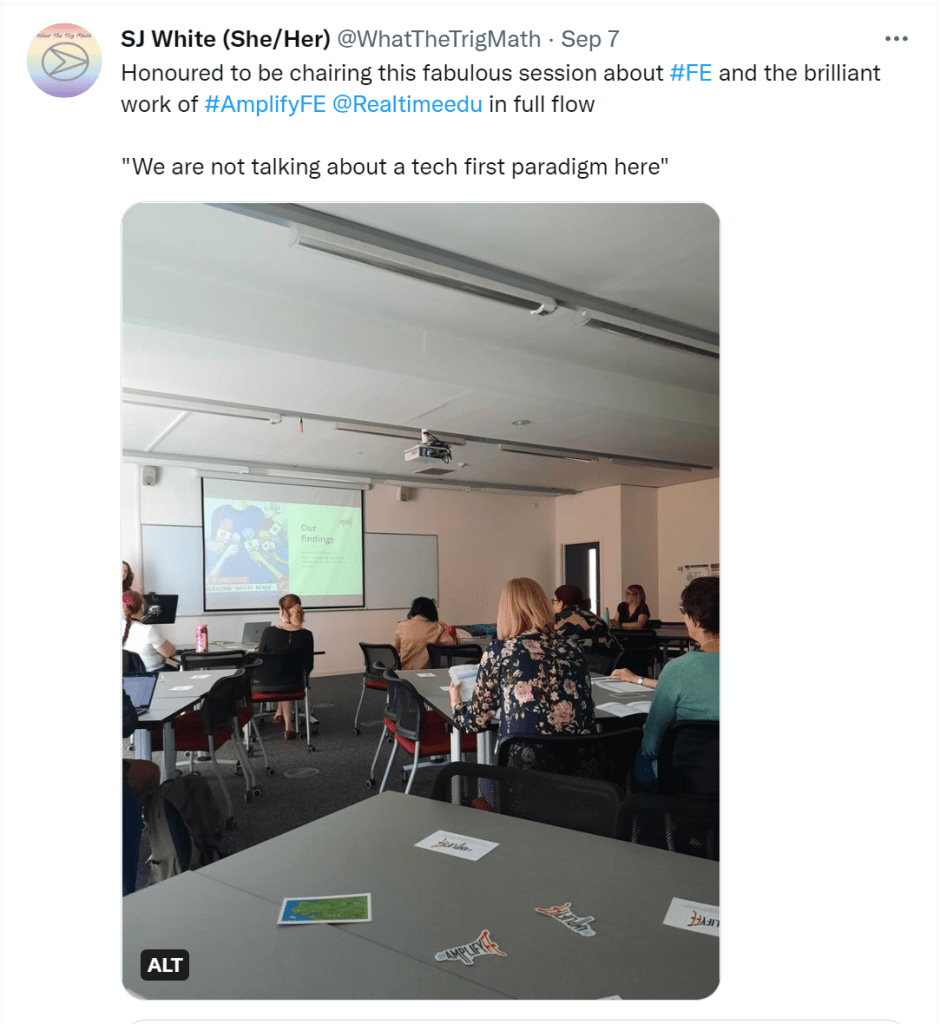
Key findings from the research are summarised in the presentation which I delivered to delegates at the ALT Conference 2022 (altc22) at Manchester University:
The Insights Report, for which I was lead author, examines in greater detail the background context to the research and the methodology employed, presents the detailed findings and recommendations of the research and acknowledges the many sector professionals and communities who contributed to it:
Once the Insights report has been disseminated to the sector in autumn 2022, a consultation exercise will begin calling for feedback on the findings. Outcomes from the consultation activity will then flow into the final report on development and deployment of learning technology which will be disseminated in spring / summer 2023.
Outcomes from the final work will be used to inform future Ufi and ALT projects and policy and steer future work of the AmplifyFE Community as well as allowing me to reframe my work as a teacher educator and vocational tutor and mentor.
Reflection
Though I have drawn upon the core principles of S/CMALT as interweaving threads through all reflections in this portfolio, here I will specifically set out my reflections against the four principles:
A commitment to exploring and understanding the interplay between technology and learning:
Much of this portfolio’s narrative examines the many benefits that deployment of learning technology brings to vocational teachers’ and learners’ development and wider lives, the voice of a technology ‘cheerleader’.
This component, in contrast, focuses on the barriers and challenges caused by deficits in access to learning technology, the impacts of the ‘digital divide’. I feel that this has been a less well-addressed topic, but one which is fortunately now gaining more focus, spurred by an enforced move to online learning during the pandemic. I hope that the research I have led for AmplifyFE will lend a voice to the growing call for efforts to narrow the divide experienced by some vocational learners.
A two-tier system exists in which many adults have access to the latest smartphones, high-speed broadband and leverage AR/VR tools during vocational studies. Work from Good Things Foundation informs us that the same time, ten million people lack basic digital skills and two million people have reduced online access, an imbalance four times more likely to impact those from low income households. For me, the most troubling statistics are that 42% of those not online act by personal choice as they are not interested or see no need to engage, 46% consider it too complicated a task and 37% lack the necessary equipment.
One of the chief outcomes of the AmplifyFE Insights research was the need for vocational educators to be enthusiastic ‘cheerleaders’ acting as digital role models, mentors and coaches. If teachers are enthusiastic advocates for technology, learners are more likely to adopt it. There is a balance to be struck, however, as over-enthusiasm can be off-putting, actually raising levels of resistance if learners or teachers believe that technology is being imposed upon them.
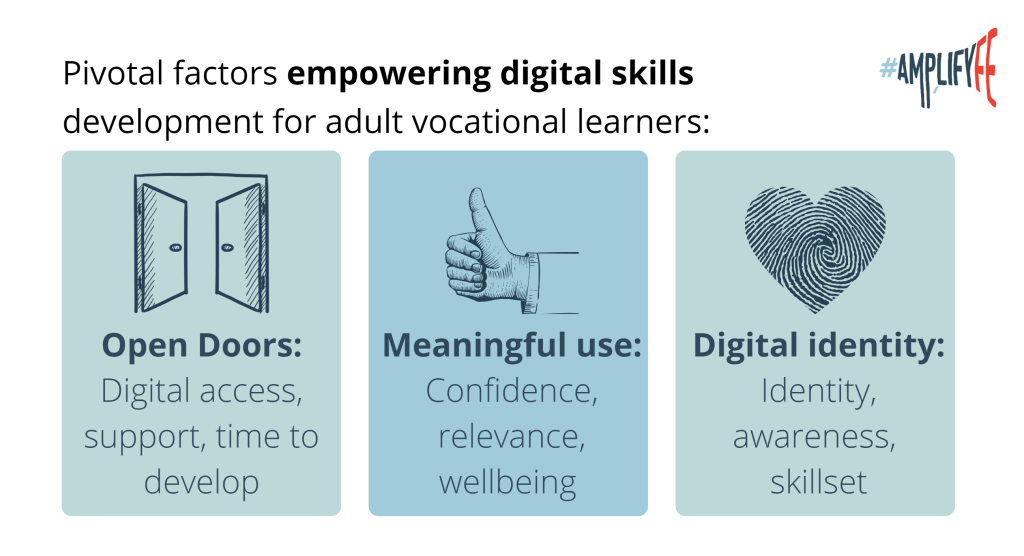
I feel that it is only by digging deeper and fully exploring the psychological interplay between teachers, learners and technology adoption that we can hope to change the minds of ‘the 42%’ who see no point in technology use. It is a complex issue beyond providing access involving meaning-making, mindset shifts and identity work as this AmplifyFE finding shows:
Having in-depth conversations with many practitioners and learning designers working with reluctant learners from areas of deprivation helped me reframe my ideas about technology use. The work reinforced a need to be informed about learners’ complex challenges, barriers and resistances regarding technology. I feel that a real danger for enthusiastic learning technologists and digitally-empowered educators is that we may fail to see that some do not share our enthusiasm, perceptions of value or our privileged ease of access.
I’m looking forward to the research consultation in the coming months when the sector has opportunity to provide feedback on the AmplifyFE research as this will bring in alternative voices and perspectives adding to our understanding of the interplay between technology, learning and learners’ needs and attitudes. Research into the digital divide must remain an ongoing process for all educators as technology and our attitudes to it develops and our economic circumstances continue to change.
A commitment to keep up to date with new technologies
Being a teacher educator is the best job in the world. I work with amazingly creative people from many different vocational specialisms putting me at a distinct advantage when keeping up-to-date with new technologies and examples of innovative use. Rather than having to seek these out, digital innovation often walks into my classroom as tech-curious teachers are keen to demonstrate the new digital tools that they are using. By facilitating a welcoming, open learning space where learning is a dialogue rather than the teacher being regarded as ‘the sage on the stage’, we can encourage this type of collaborative, participatory learning.
I think that key to this is being absolutely open and honest with learners about ‘mastering technology’. There are so many diverse systems and applications, especially in workplace scenarios and vocational learning, that is not possible for anyone to be more than contextually well-informed, let alone ‘keep on top of it all’. Once I found the confidence to share this with students, they relaxed. Pressure is removed by the insight that we don’t need to ‘know it all’, simply be tech-curious, willing to learn from others, and adopt an informed approach to technologies that will serve us well – and those that will not. I find that simply saying ‘no, I’ve never heard of that app, let’s research it and find out together if it’s useful’ requires confidence when admitting the vulnerability of not knowing, but promotes collaborative exploration.
When conducting research for AmplifyFE Insights I’ve also had the privilege to have dialogues with vocational technology teams from areas as diverse as construction and garment manufacture. In doing so, I have gained insights into the technology they use and their learners’ needs and challenges. During these interactions I view myself as a ‘technology magpie’, keeping a Padlet board ready to paste in information about apps and tools I hear of that I I’m unfamiliar with so that I can research them and appraise their value to keep my knowledge and skills current and relevant.
This is work that never ends because of the pace of evolution and innovation, but I think does not need to be overwhelming or debilitating if we adopt a curious, above all, critical mindset.
An empathy with and willingness to learn from colleagues from different backgrounds and specialist areas
As noted above, I am privileged as a teacher educator to have access to the knowledge and skills of professionals from a wide variety of vocational contexts. I also work actively to maintain a diverse professional network through my work with FE Research Meets, AmplifyFE, #ukfechat and membership of ALT and BERA. I also felt tremendously privileged whilst conducting the AmplifyFE Insights research to call upon the time and expertise of many knowledgeable professionals working in vocational learning technology design and employment. The analysis of their perspectives and the production of the summary presentation and detailed report word for me the most amazing professional updating activity.
I feel that this particular core S/CMALT principle is particularly well-phrased as it balances a willingness to learn from colleagues with an empathy with them. Though the AmplifyFE Insights research focussed upon the digital divide’s impacts upon vocational learners, there are also inequities in many educators’ access to technology and opportunities to develop skills and pedagogy regarding it.
Some practitioners in my professional network work in large FE colleges with flexible, technology-enabled learning spaces and develop innovative personalised, hybrid learning. Others, in both rural areas and community settings in urban locations, are not so fortunate, struggling on limited budgets with portable digital kits transported in car boots and little or no network access. I feel we can learn as much from those doing inspirational, creative work with limited budgets and technology access ‘work-arounds’ and need to recognise and promote this innovative work as much as we do cutting-edge applications. This was highlighted by the innovative prison-based OTLA researchers who developed learners’ skills and knowledge on social media, digital device use and online purchasing systems use using entirely paper-based resources (see Specialist Area 2).
I feel it is especially important for me to use my voice as an advocate for teachers impacted by the digital divide. FE leaders and managers have commented to me that shortfalls in technology use are most likely due to a lack of motivation from educators, when teachers are instead frustrated by access and training shortfalls, and importantly, a lack of time to experiment and integrate technology into their pedagogy. I think the most important thing that we can do is recognise that ‘teachers are learners too’ and need to be afforded the same respect and opportunities as we would any developing vocational learner. As my doctoral research revealed ‘community is key’. By encouraging teachers to collaborate and share their expertise using an open ethos, the whole sector will be better able to grow more knowledgeable digitally.
A commitment to communicate and disseminate effective practice.
The key word that I want to reflect on here is ‘communicate’ as the idea of disseminating effective practice sits uneasily with me. Dissemination brings to mind a ‘banking concept’ of education where knowledge is transmitted to listeners, which stands against my Freirian ethos. Freire contends that teachers must be unafraid of risk, challenging themselves and those they work with to ‘critically consider reality’ (1998:72) working together as collaborators and co-designers empowered to view reality as ‘in process, in transformation’ (1993:81). I think that this ethos is particularly important for teacher educators and those working in designing and deploying learning technology as we work in a world that is innovating and unfolding so quickly before us.
In the last couple of years I have been lucky enough to discuss my netnographic doctoral research at BERA regional and national Conferences, a national FE Research Meet and at the IPFREC Conference. The ALT/Ufi AmplifyFE Insights research outlined here was showcased at the ALT annual conference. In all cases I wanted this work to be a dialogue with the audience, a two-way communication allowing all present to engage in critical reflection and questioning.
While as learning technologists and teacher educators we must seek to communicate ‘what works’ for us, I feel this must be always combined with a listening exercise as no ‘one-size-fits-all’ recipe exists for technology design or deployment. A key message that AmplifyFE Insights research reinforced was the need to be sensitive to the needs of educator and learner end-users, to work with them to co-construct technology-enabled solutions, not impose them.
Now that the initial phase of the AmplifyFE Insights research is complete and the report is soon to be published I’m eager for the consultation phase to begin. Then, I can work to gain more and diverse perspectives on the vital question of how can we best design and deploy learning technology to meet the needs of the vocational learners most in need of its benefits.
References:
Freire, P. (1993) Pedagogy of the Oppressed. London: Continuum International Publishing Group.
Freire, P. (1998) Teachers as Cultural Workers: Letters to Those Who Dare Teach. Australian Journal of Teacher Education, 23, Vol 3, Issue 1, 1998.
Return to SCMALT portfolio main page
 Lynne Taylerson SCMALT Portfolio