Dr Lynne Taylerson: SCMALT Portfolio, Summer 2022

An opening word on vocabulary: This portfolio will use the abbreviated, umbrella terms ‘FE’ or ‘post-16 education’ to describe the rich, diverse ecosystem of learner groups and individuals, learning providers, scenarios and locations which comprise education in the FE and Skills sector for post-compulsory learning. This goes far beyond General Further Education (GFE) Colleges to include Adult and Community Learning (ACL/ AE), Independent Training Providers (ITPs), work-based learning (WBL), prison learning and more.
The term ‘classroom’ or ‘learning space’ is generally used to convey the situations where learning occurs except when in an online or hybrid scenario, where this facilitation mode is made specific.
In 2016 I completed my original CMALT portfolio and gained Certified status of ALT. At the same point, I undertook a significant career and life change, leaving work in full-time FE in a large GFE College to found Real Time Education Limited, a small, Midlands-based Independent Training Provider (ITP). From then until 2020, when I updated my CMALT accreditation, work remained fairly stable involving facilitation of mostly in-person adult and professional learning in spaces across the country along with some online asynchronous learning design.
In early 2020, this work involved a mix of:
In-person initial teacher training (Pearson/ NOCN Award in Education and Training) for a national Recycling/ Logistics Apprenticeship provider Mayer Environmental/METacademy and a local Group Training Association, HWGTA.
In-person IT and digital skills one-day sessions for HWGTA and skills development for tutors and leaders.
Digital specialist work in FE teacher/manager CPD to prepare the sector for the launch of T Levels. This involves designing and facilitating English, maths and digital skills (EMD) CPD for DfE/ETF both in-person and via online digital skills modules accessed via ETF’s website (in partnership with ccConsultancy) as part of the TLPD programme
Design and facilitation of ETF’s ‘#Study Good’ FE teacher development programme supporting vocational contextualisation of English, maths and digital (EMD) skills development in partnership with touchconsulting.
Pro bono work for ALT as part of the organising committee for the ALT OERxDomains conference and as a member of the Steering Group for the ALT West Midlands Group.
In addition to this core work I was in the final stages of completing a PhD in Education through Sunderland University’s SUNCETT Centre investigating FE educator’s use of social media spaces for informal professional learning.
The pandemic and resulting lockdowns, which prevented in-person learning facilitation, enforced radical changes on my working life and the operation and curriculum offers of Real Time Education. While there have been terrible personal losses and much financial hardship for many in the UK and worldwide, the ‘pandemic turn’ provided a huge, fresh impetus for online, blended and hybrid learning and the leveraging of learning technology. Importantly, I feel that enforced circumstances have led to the development of more informed digital pedagogy by necessity. This SCMALT portfolio is largely a record of my responses to these pivotal changes in life and work since April 2020.
A word on evidence and reflection
Each portfolio section consists of 2 elements. The first, evidence in text, images and hyperlinks, the second a reflective passage, including details of underpinning literature.
My reflections have employed 2 thinking and writing frames, the combination of which I have found valuable for facilitating deeper reflection.
The first is the the four guiding principles detailed in ALT’s SCMALT guidance:
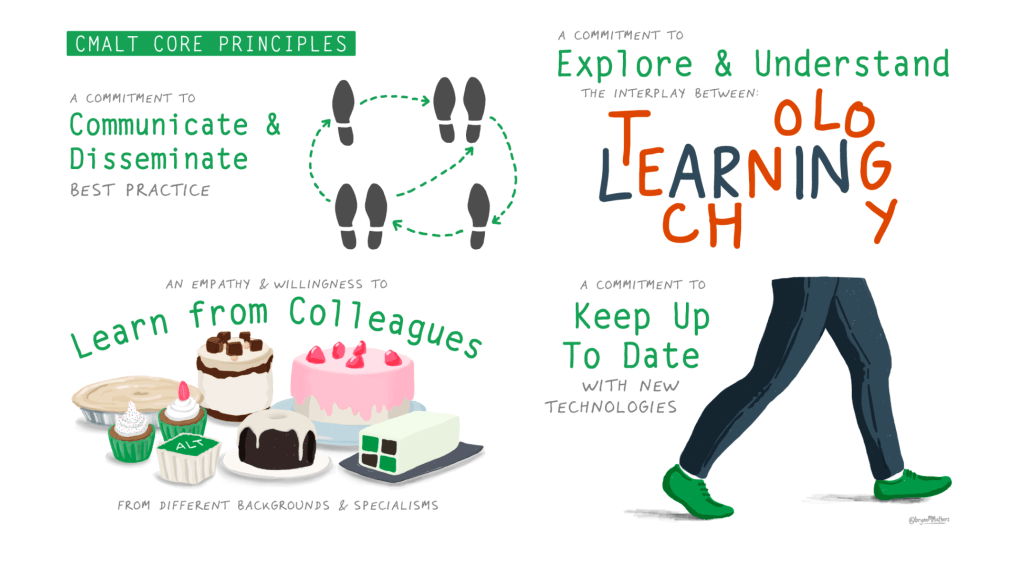
The second is the reflective framework ‘Brookfield’s Lenses‘ (Brookfield, 1995) which requires the person reflecting to consider the topics and issues concerned from 4 key perspectives:

References:
Brookfield, S.D. (1995) Becoming a critically reflective teacher.
San Francisco: Jossey-Bass.
 Lynne Taylerson SCMALT Portfolio