An understanding of the constraints and benefits of different technology
This sub-section also provides additional, cross-cutting evidence for portfolio section 1b, Technical knowledge and ability in the use of learning technology.
Context:
As a case study for this portfolio section I will outline and reflect upon moving the NOCN accredited initial teacher training course, the Level 3 Award in Education and Training, from wholly face-to-face delivery to entirely online facilitation. This provides a perfect illustration of the pedagogy and learning technology considerations that need to be considered in the move to online learning and my ability to select and use technology.
I designed this 3-module course for MET Academy, an apprenticeship provider for the recycling and logistics sectors and had facilitated it for the past 5 years at their training centre in Nuneaton.
Delegate profiles were highly diverse, ranging from senior managers educated to doctoral or master’s level to drivers and warehouse operatives with few formal qualifications. As well as having spiky profiles, delegates came to the course with widely different experiences of digital tools and online learning. Established face-to-face sessions allowed me to build these skills and the confidence and communication skills required for delegates’ transition into teaching and training. Groupwork formed an important part of the experience, so it was particularly important to be able to replicate the conversational, collaborative environment in the move to online facilitation.
The aims of the course were twofold. First, I needed to enable candidates to successfully pass the Award. Secondly, I needed to enable them to develop as educators who could successfully use a range of digital learning strategies with the colleagues and learners that they would work with during and after lockdown, to fit them for future digital pedagogy. This involved modelling as wide as possible a range of learning technologies allowing delegates to be academically successful and develop the digital skills and pedagogy to be confident, nuanced technology users and advocates for digital learning.
Solution:
My technology solution to online facilitation was to convert the four full days of delivery into eight half-days in order to minimise stress, fatigue and ‘online overwhelm’ for delegates. The three-hour sessions were facilitated using the Zoom platform. A familiarisation session before session one was provided to allow those unfamiliar with Zoom to experiment with joining a webinar, using their camera, microphone and the chat features as well as sharing their screen, annotating a shared whiteboard and navigating around the desktop.
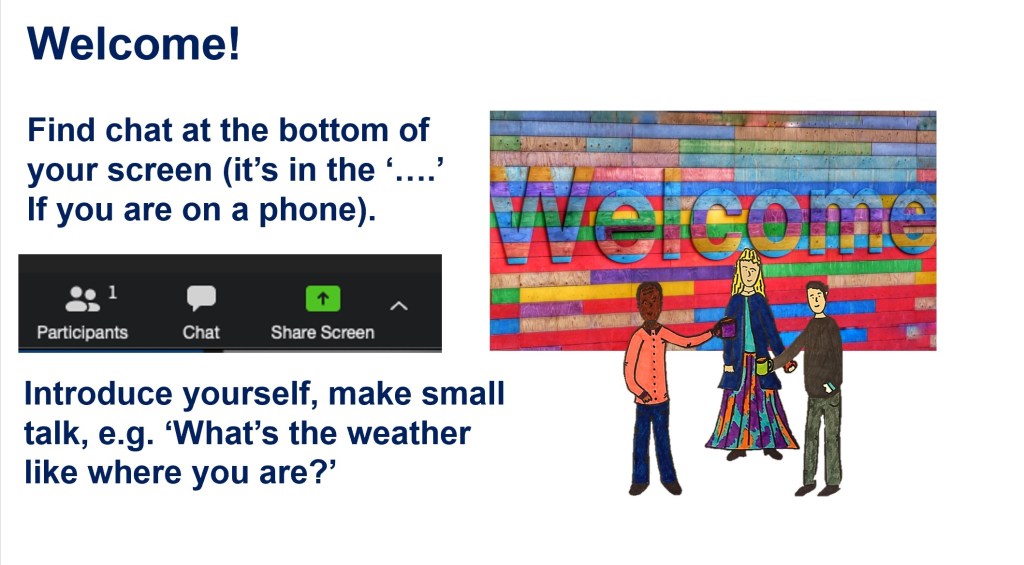
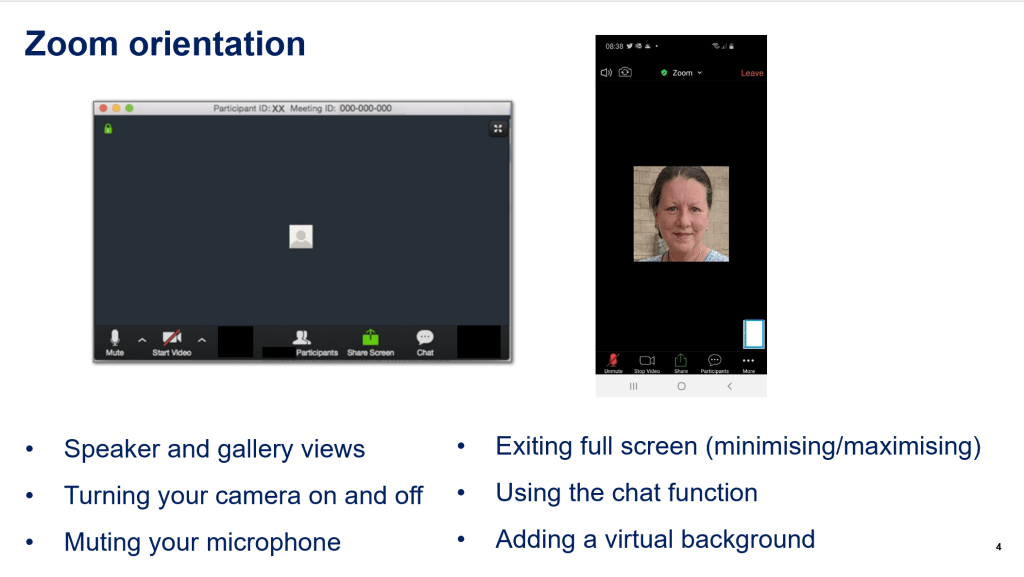
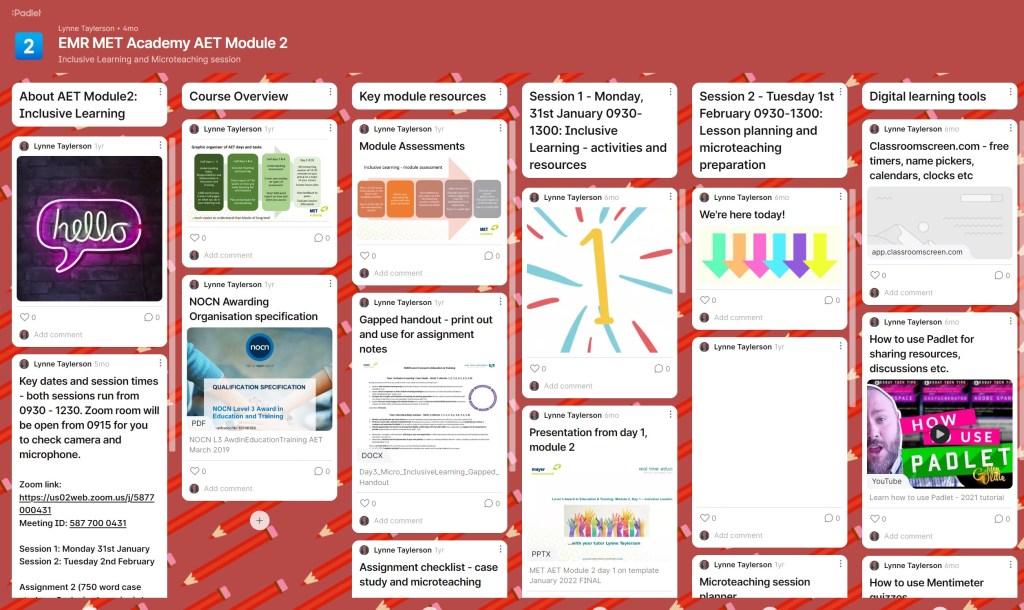
Webinars were supported by dedicated Padlet boards for each module enabling me to post course information, reading and resources, and importantly model how a teacher might use animations and media files that they have sourced online or recorded themselves. Just as importantly learners were able to ‘make each Padlet their own’, sharing weblinks to specialist industry websites and documents and uploading reflections and discussion comments. This provided a powerful record of learning which could be used in the learners’ assignments:

Use of a wide range of Mentimeter quizzing strategies and question types allowed me model use of haptic formative assessments including drag-and-drop, simple priority ranking and 2×2 grid ranking plotting, use of scales and pin-on-image response types. I also used multiple choice, pin-on-image, open ended responses and word clouds (including the example shown below on causes of disruptive behaviour in learning spaces) for polling of learners on their preferences and reflections on impact of the sessions.

Mentimeter word cloud example
To model the reflective cycle and reflective practice I held a 15-minute ‘digital debrief’ at the end of each session using Kolb’s model (Kolb, 1983) allowing learners to unpack feelings and ideas about the online learning experience and share what worked best and less well for them. This also acted as a useful informal social space to allow delegates to decompress and relax after busy online learning.
Assignments were submitted online via email with digital feedback to provide a level playing field for those without access to the organisation’s LMS.
Reflection on Technology Constraints and Challenges:
As noted above the teacher educators’ role is not only to successfully select and deploy learning technology for learner engagement and success, but also to model digital learning options and opportunities for delegates. This action enables delegates to experience digital tools and networks as their learners would, developing their capacity to critically evaluate them for use in their own practice.
The first significant constraint was a lack of digital learning culture or significant technology deployment across the organisation stemming from, I considered, an absence of coherent digital learning strategy. I had observed that this had resulted in a piecemeal approach to learning technology deployment in which individual educators largely adopted individualised, fragmented approaches regarding digital and online learning.
Secondly a huge constraint was in place related to the in-house LMS. A restricted installation of the SmartAssessor platform, designed specifically for use with apprentices on their learning journeys, was in place. The five specialist tools provided by the full installation of the platform when fully integrated allow seamless entry guidance, initial assessment, learning facilitation, formative and summative assessment and quality assurance, however these were not in place affording me only a basic summative assessment upload and feedback facility.
On previous teacher training courses I had facilitated at How College, an integrated Moodle platform was deployed. I was able to model and allow learners to experience integrated, multi-modal resource provision, formative assessment via a range of engaging haptic quiz types, use of asynchronous discussion forums and integrated summative assessment and feedback. Use of the Lessons tool in Moodle allowed me to provide differentiated paths through resources and contextualised activities depending on learners’ formative assessment outcomes affording them access to ‘personalized instruction with some… control over path, pace, time, and place’ of engagement (O’Byrne and Pytash, 2015:137). The Moodle platform also allowed me to showcase the types and uses of assessment metrics provided by a modern LMS thereby enabling learners to have a realistic experience of the use of a sophisticated system to appraise learner presence, engagement with resources and assessment outcomes. This experience enabled trainee teachers to have opportunities to build the transferable learning technology management skills required when an educator deploys other similar platforms such as Canvas or Edmodo.
I was able to give trainees access to my organisation’s own in-house Moodle platform if I wished but after discussions with the client it was decided that use of the in-house SmartAssessor platform in parallel with the Real Time Moodle would be onerous for learners with little online learning experience as 2 log-ins would be required and there may be confusion between the purposes and operations of the 2 platforms.
The challenge of having use of only a very basic, assessment-focussed LMS, not easily available to all learners, particularly those not working for the organisation, put me in the position of many educators working in our sector. This experience is familiar to many educators in scenarios such as some offender learning, adult and community learning and independent training provision where organisational budgets may not stretch to a sophisticated LMS and a coherent digital learning strategy may not yet be in place. These trainee teachers needed to be given access to and experience with free digital tools which they could leverage, and, in this scenario, I needed to use these tools too!
Reflection on Approaches to Technology Deployment:
There were many constraints governing my choice of technology and curriculum scheduling for this diverse learner group. Some worked within the MET organisation, others offsite with learning partners, some from home, others from their organisation’s premises. Some delegates would be able to leverage the webinar-capable in-house Learning platform, SmartAssessor, others would not, so I was mindful that free and easy accessibility to the chosen solution for all was vital.
By using a combination of Zoom webinars for online facilitation with Padlet boards to share resources and gather the outcomes of discussions and practical tasks, I modelled a powerful, accessible way in which trainee teachers could facilitate their own future online learning sessions using free, easily accessible tools. This was preferable to requiring learners to master my company’s own platform, Moodle, which would be redundant for them past course-end, and may have been onerous, unproductive and challenging for learners with little experience of online learning.
What most pleased me about my choice of solutions was that the majority of teacher-learners told me that before the end of the course they had experimented with using Zoom for learning and tutorials with their own students or had created Padlet boards to disseminate resources for learning. I took this as affirmation of the importance of a teacher trainer modelling digital tools and pedagogy effectively and accessibly. Allowing learners to take the lead, experiment and have ownership of the Padlet boards and shared Zoom whiteboard in the webinars were particularly important factors in successful digital uptake.
The assessment procedures I put in place allowed me to model use of hand drawn annotations, margin comments and audio feedback via Mote, which allows more relatable, personalised and hopefully motivational feedback (EEF, 2020). For learners who were gaining experience with formal academic essays the use of annotations, highlighting and reordering blocks of text allowed me to demonstrate how they could present future work with a more logical and appropriate structure. Several teachers commented that this had encouraged them to use annotation, highlighting and margin comments for the first time rather than printing out and marking assessments by hand. Others had been encouraged to provide personalised audio feedback to learners which was well received and also removed the need for teachers to do so much typing, which they disliked.
Though moving online allowed all learners to successfully complete the course, several while safely socially distancing at home, technology imposed constraints. Some delegates were forced to join sessions via mobile phone or tablet due to device shortages which removed the flexibility of conventional keyboard-typed chat and Padlet comment responses. They were encouraged to create flipchart summaries and upload photos or experiment with uploading audio or video snippets to summarise reflections and discussions, thereby modelling more accessible, alternative uses of technology to the group.
Other learners experienced delays and frustration with reduced bandwidth causing slow access. This made me reflect on the timing and scheduling of future sessions, as meetings on Monday mornings were particularly badly disrupted. That said, working around this patiently, giving learners time to reconnect and giving regular precis of learning allowed me to model further digital pedagogy and demonstrate how they will need to manage online spaces which have similar issues.
The reflective ‘digital debriefs’ at session end were a very valuable segment for me as I gained new perspectives on ‘what worked’ and what was less popular when facilitating online learning for this type of professional group. Learners reported that they were very glad that the decision was taken to have twice the number of shorter sessions. Several of them reported suffering some digital overwhelm toward the end of sessions, even with meetings in their shortened form, something that I must be mindful of in future when scheduling online learning. There is of course a trade-off between minimising digital fatigue and dividing curriculum up into so many segments that it may lose coherence or become more challenging for some learners to attend.
References:
Education Endowment Foundation (EEF) (2022) Feedback: very high impact for very low cost
[online] Available from: https://educationendowmentfoundation.org.uk/education-evidence/teaching-learning-toolkit/feedback. Accessed on 11/09/2022.
Kolb, D.A. (1983) Experiential Learning. London: Prentice Hall.
O’Byrne, W. I and Pytash, K. E. (2015) Hybrid and Blended Learning: Modifying Pedagogy across Path, Pace, Time, and Place.
Journal of Adolescent and Adult Literacy, Vol 59 no. 2, pp 137-140 September, 2015.
Return to SCMALT portfolio main page
 Lynne Taylerson SCMALT Portfolio