The Scholarship of Technology Enhanced Learning
My doctorate was completed in April 2020 (via Sunderland University’s first pandemic-necessitated Skype viva!), and funded in part by ETF’s Practitioner Research Programme (PRP) for FE educators researching their own practice. The work investigates the value to FE practitioners of informal online professional learning and in the spirit of an Open ethos the final work is available on my ResearchGate space under a CC-BY-4.0 OER Commons license.
Here, I will outline the research process, strategies, main findings and comments from the PhD viva panel. In the reflection section will share thoughts on the value of the work to myself and the FE community. and how technology made possible, shaped and steered the work and its dissemination.
I had always benefited hugely from the professional networks I had cultivated via Twitter including valuable connections built via #ukfechat, #ukedchat, LTHEchat, various ALT networks (national and regional) as well as online networking opportunities with teacher educator and learning technologist peers on a 1-1 basis (see Core Area 4 for cross-cutting evidence on community activism).
Involvement in the networks made me aware of new literature, digital resources and strategies as well as CPD and further networking opportunities I would not have been aware of, especially in my case due to mostly solo working in a small ITP. Anecdotal evidence from informal conversations with peers suggested I was not alone in these benefits.
When the opportunity to conduct research at doctoral level into an aspect of my practice arose, FE teachers’ informal online professional learning was an obvious choice. In fact, it was a Twitter dialogue that first made me aware of the ETF’s PRP (which partially funded and entirely academically supported my doctorate) when a member of my online network tweeted a message about the deadline for applications for it. Before this I wasn’t aware that the PRP even existed!
Beyond personal interest in the growth of CPD dialogues in informal online spaces, I was aware that literature was informing us that informal, online professional learning conversations were becoming more popular with FE educators, while more conventional CPD routes may be becoming less well received. This was therefore an area worthy of further academic study.
In 2018, the year that I began doctoral study, the Education and Training Foundation’s workforce data (ETF, 2018) informed us that almost 40% of FE respondents stated that some CPD undertaken did not meet their needs. Educators’ participation in formal CPD declined (UCU, 2016), yet informal, social media-based dialogues were ‘burgeoning’ in terms of participation and academic interest, (Bergviken-Rensfeldt, Hillman & Selwyn, 2018:230). The rhizomatic online spaces where ‘community is the curriculum’ (Cormier, 2018:1) were growing in number.
My work centred around the following research questions:
1. How do FE teachers who participate in informal, online educators’ networks consider that they are engaging in meaningful professional learning?
2. In what ways would the topics addressed during dialogues in online educators’ networks be regarded as key development areas for FE teachers by recognised sector bodies?
3. What evidence do educators report of any formal recognition of impact from informal online learning opportunities?
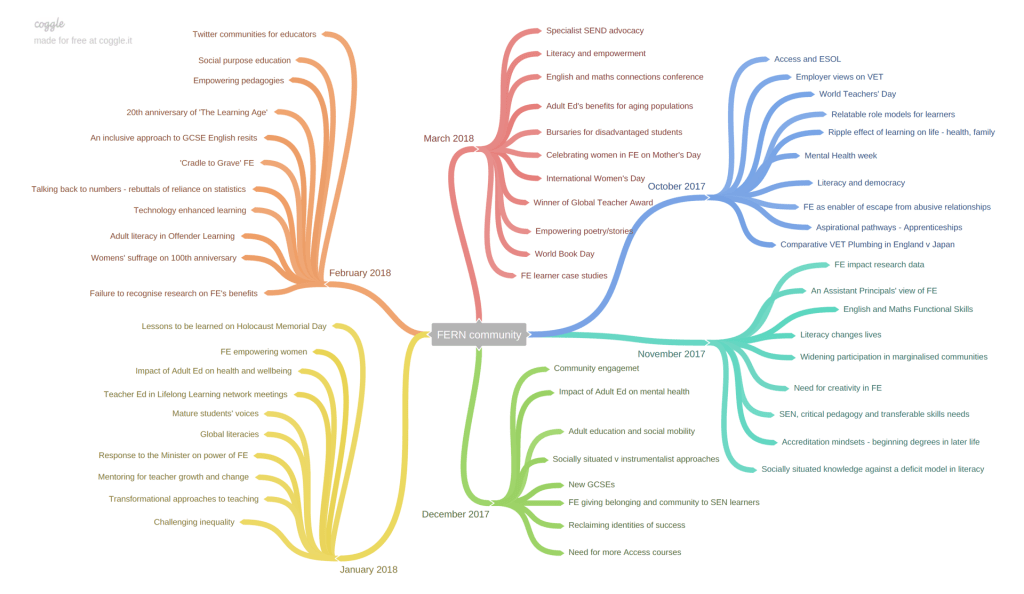
My research began with a netnographic study (Kozinets, 2015) which analysed activity on 3 popular Twitter-based FE educators’ communities over a 6-month period. I used Coggle maps to aggregate the dialogue themes from these networks using low inference descriptors taken from Tweet hashtags. An example of a network activity map can be seen here:
The thematic analysis of dialogues which followed revealed that online discourses fell under 3 lenses, represented in the model below:
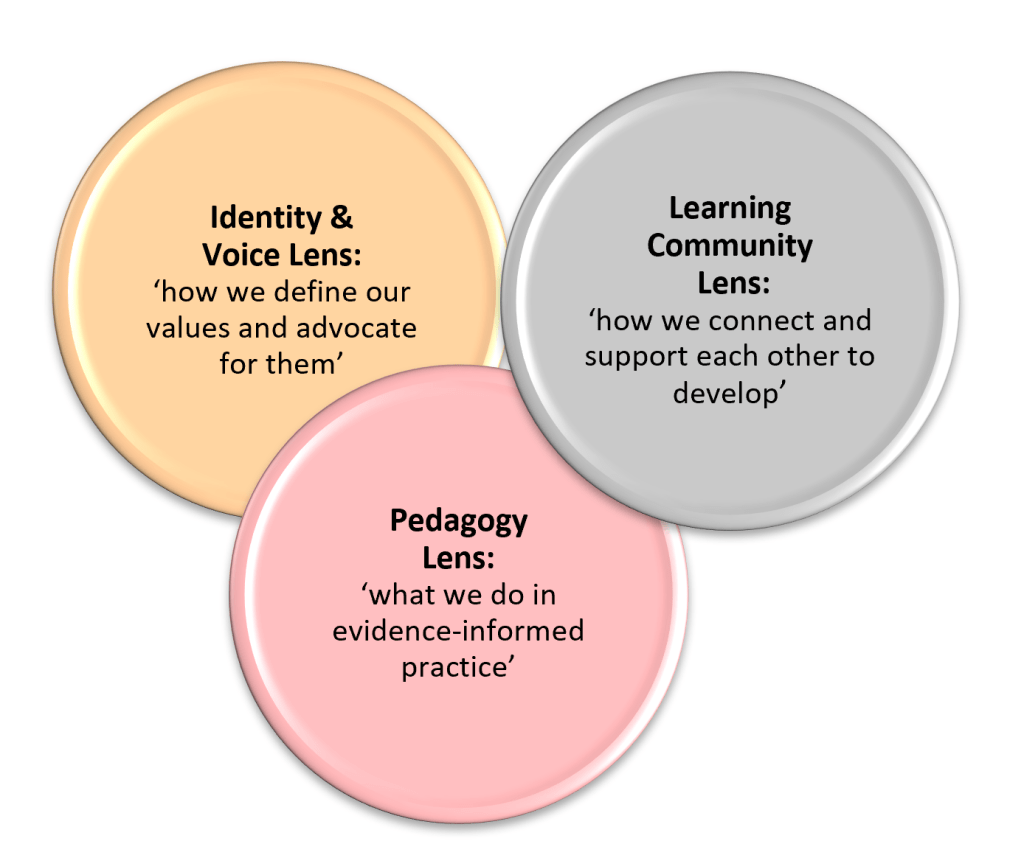
The ‘Pedagogy’ and ‘Learning Community’ lens discourses showed teachers collaborating to build technical and practical wisdom and build and grow open, online learning communities and professional networks. Dialogues under the ‘Identity and Voice’ lens spoke to educators’ demands for agency in CPD choice and a desire for holistic, democratic learning experiences for their students. Value-laden, political engagement was a key part of participating educators’ identities. Community participants advocate for Social Purpose Education and discourses oppose both the neoliberal ‘learning for earning’ agenda (Biesta, 2005:688) and reductive, ‘tick box’ approaches to learning and judgement of teachers.
Two focus groups and twelve 1-1 interviews engaging with 28 FE teachers and managers followed the netnographic element and enabled member checking corroborating the value of the ‘3 lens’ model.
In keeping with the Twitter theme, I conveyed educators’ authentic voices in vignettes via ‘fake tweets’ giving each participant a signifier showing their role yet safeguarding anonymity. I differentiated contributions by using a blue border for 1-1 interview contributors and a green border for focus group respondents:
![Screen shot of 3 'fake Tweets' showing comments made by 3 FE teachers on their perspectives of online community use and the 3 lens model of community activity.
Comments read:
1, from 'Julia':
The lenses make total sense. All 3 are areas that have broadened my ideas about my role. The final [identity] lens has been particularly powerful. Participation is very much about having a voice and exploring identity.
2, from 'Anya':
I agree with the concept of 3 lenses. A lot of topics under the pedagogy lens are mechanistic, what works, a compliance agenda. Teachers are digging underneath to ask more fundamental, critical questions on what underpins what we do.
3 from 'Rhys':
The 3 lenses stand up… they’re worthwhile. We’re asking, ‘what is there here to learn? in a relaxed setting. What am I seeing, what does it mean, how does this fit with what I already know, my identity?](https://ltscmaltportfolio.co.uk/wp-content/uploads/2022/09/fake-tweets-conveying-1-1-interview-and-focus-group-quotes.png?w=1024)
Participants corroborated the validity of the 3-lens dialogue model, reporting that they gained valuable professional learning, networking opportunities and a sense of solidarity in their professional identity and values. Discourses went some way to replace a sense of community less prevalent in a sector where fractional contract working and time pressures has eroded the staffroom learning culture. Many contributors noted that they had not fully considered the benefits and value of their social media-based professional networks until reflecting upon the topic before they were interviewed.
That said, engagement with online communities was not unproblematic. The vast majority of participants did not formally document the learning or outcomes from informal online activity as they would formal CPD or disseminate outcomes widely to colleagues. Only one interviewee brought outcomes from Twitter dialogues into formal, organisational CPD conversations.
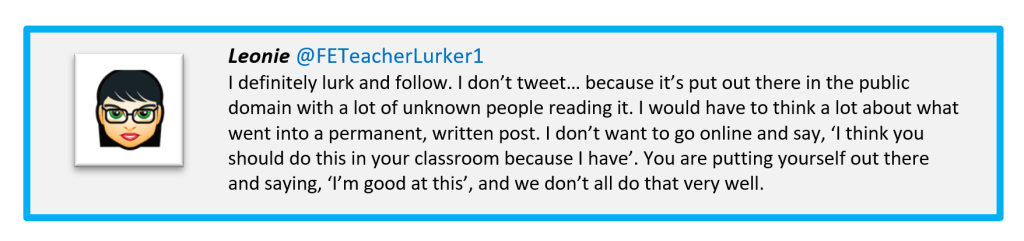
During the interview activity, it was also particularly challenging to capture the voices of ‘lurkers’ (Kozinets, 2015) who observed dialogues but did not participate or who did not use social media professionally. I was pleased to be able to interview two experienced practitioners who fell into this category by putting out a call for this user type on social media and guaranteeing anonymity of response. It was fascinating to discover what deterred them from participating:
![Fake tweet 1 from 'Leonie' stating:
When people like a tweet you don’t know the basis for why that was or even who they are. You can say whatever you like and it can’t be checked. People talk a very good talk but what does it mean? If 20 of us said ‘this is the strategy to use’ we might not have used it but it could become a new standard. That’s 1 reason I’m not ready to come out [stop lurking] yet.](https://ltscmaltportfolio.co.uk/wp-content/uploads/2022/09/fake-tweets-conveying-lurker-perspectives.png?w=1024)
The conclusions and recommendations from my research were:
Participating teachers should actively encourage peers to join informal online dialogues and raise awareness of community value with their managers and sector policy-makers
Entrants into FE teacher education and established teacher educators should be enabled to integrate use of online communities and learning technologies into their pedagogy in an informed, evidence-based, contextualised manner. Use of the 3-lens model and authentic voices of educators conveyed as vignettes in this thesis can be valuable devices allowing teachers to explore social media-based pedagogies and integrate them into practice
All FE teachers should become researchers into their own practice as an engine for personal and professional growth, to explore their identity and to question or affirm their place in the sector, enabling them to be a more confident, connected part of post-16 education.
Teachers must be allowed to exercise agency in decisions and actions around their professional learning rather than being compelled to participate in one-size-fits all, bite-sized, teacher CPD ‘events’ aligned to the performative, instrumentalist CPD agenda prevalent in the sector. FE teachers are experts who should decide and action their own professional learning and must be given an investment of time and funding and allowed to form learning networks both on and offline.
ETF’s Professional Standards reflect Government priorities casting teachers as makers of skilled employees for the workforce, so employability, Functional and technology-related skills are prioritised. The ETF Standards intersect but remain at odds with the identity and values of FE teachers who value community and prioritise education for social justice and personal and community growth and wellbeing. The Standards should be reviewed, authored and owned by the teachers to form co-created professional standards over which they have ownership.
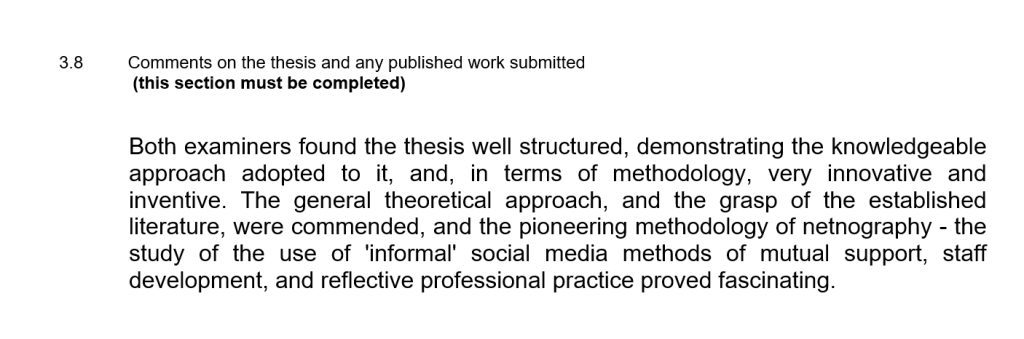
The PhD examiners on the viva panel commended my ‘fascinating’, innovative and inventive research and the ‘pioneering’ netnographic methodology:
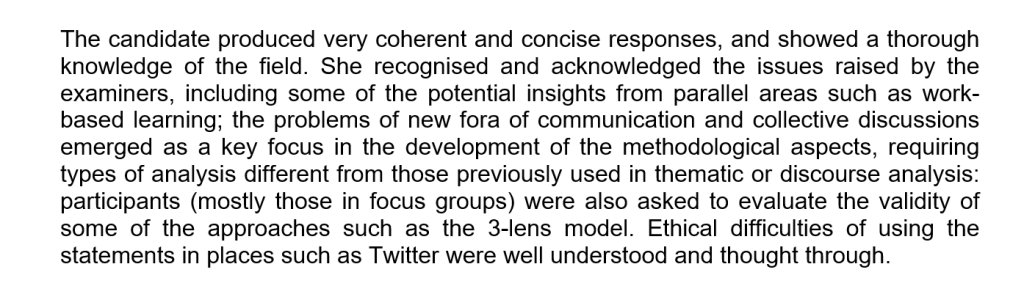
They also commended my ‘thorough knowledge of the field’ and robustness in ethical approach:
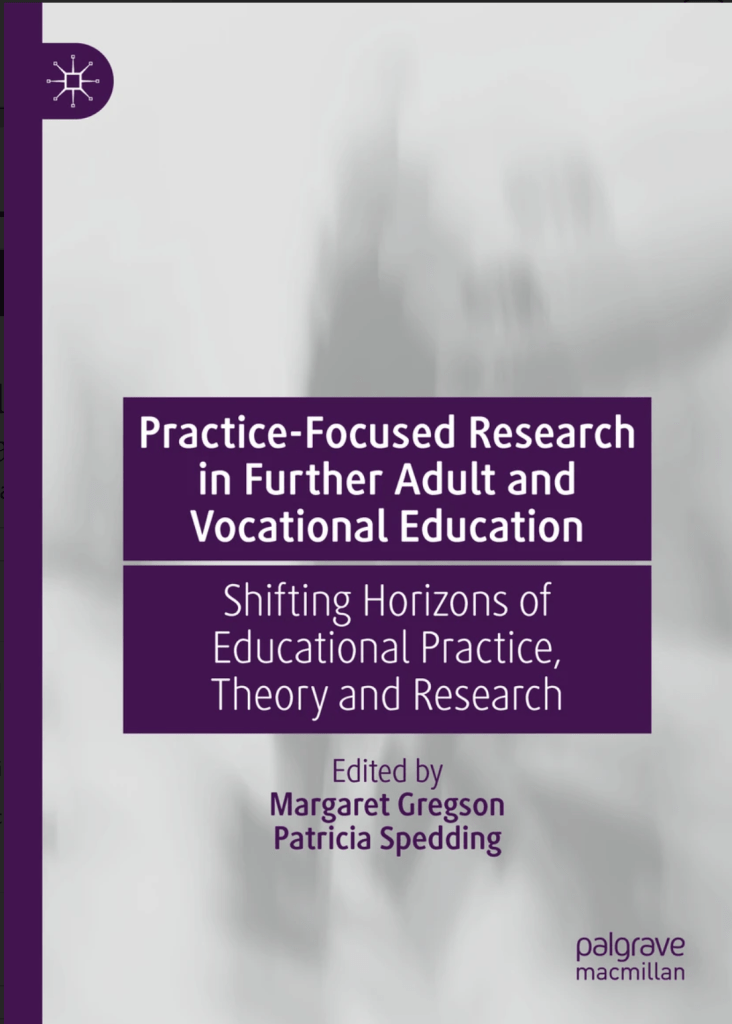
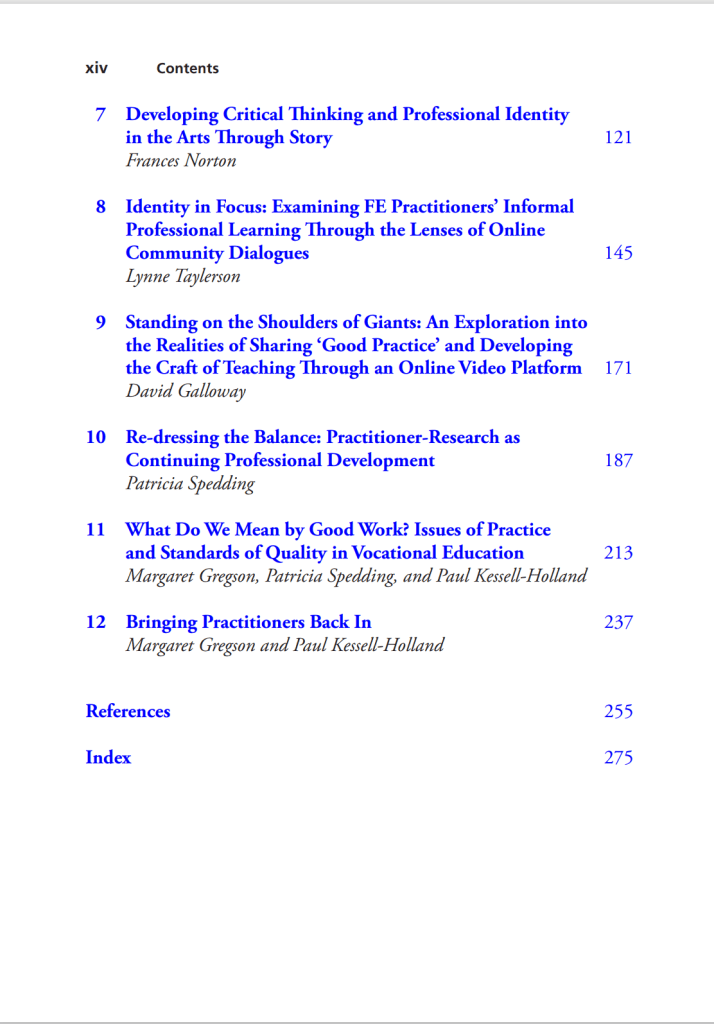
I was delighted when in 2020 the Sunderland University team offered me the opportunity to have a summary of my research background, methodology and findings published in the Springer book ‘Practice-focussed Research in Further, Adult and Vocational Education‘ in a chapter entitled ‘Identity in Focus: Examining FE Practitioners’ Informal Professional Learning Through the Lenses of Online Community Dialogues‘:
Reflection
I think it is a fascinating to reflect upon how closely my recent PhD research aligns with the S/CMALT values of having a commitment to exploring interplays between technology and learning, keeping up-to-date with new technologies, having an empathy with and willingness to learn from diverse colleagues and specialisms, and a commitment to communicate and disseminate effective practice.
Technology does not just have an interplay with my doctoral study, rather it guides and underpins the work throughout. Reflecting back, technology is at the core of the work and it is fascinating to consider the range of technology applications and uses that made the work and its dissemination easier, or in some cases, possible. Use of social media networks for learning is, of course, the theme of the work, but during my studies I leveraged Zotero for referencing, MS Word for transcribing interviews and writing up the final thesis, MS Excel for tracking interviews and focus group correspondents, a WordPress blog for putting out calls for contributors and disseminating findings, Adobe Illustrator for creating inset graphics and ‘fake tweets’, Zoom and Skype for conducting the majority of interviews. Twitter, Facebook, LinkedIn and a WordPress blog were leveraged for its dissemination.
I promoted my work and disseminated its findings at several online conferences including British Educational Research Association (BERA) conference 2021 and the International Practice-Focussed Research Conference (IPFREC) 2021:
Secondly it’s interesting to observe how events kick-started by the Covid-19 pandemic impacted on teachers’ professional learning and the prominence and popularity of learning technology and online professional networks. The full effects of the Covid-19 pandemic began to be felt when nationwide lockdowns began the month after I gained my doctorate, and soon all learning – for FE students and for their teachers – moved online by necessity.
The majority of recommendations proposed in my thesis were enacted faster than I could ever have imagined due to events out of FE teachers’ and leaders’ control. Organisations were compelled to develop digital pedagogies and use of learning technology and give the educators working in FE the resources, if not the adequate time, to explore their use. Ironically this is something which fellow learning technologists and I had been strongly advocating for many decades!
The same online trajectory was equally witnessed in teachers’ professional learning. Unable to meet up for conventional CPD events and conferences, formal and informal online teachers’ communities quickly flourished, and it is encouraging to note that many of these learning opportunities remain online as a first preference, therefore bringing a much greater number and diversity of participants together in online dialogues.
The move to online learning was of course, not problematic, being a very stressful time for many teachers less accustomed to using learning technology and digital pedagogies. Impacts on both teachers and learners due to the ‘digital divide’ and shortfalls in digital skills, knowledge and device and network access were felt profoundly, something that is explored further in the final element of this portfolio, the Advanced Area.
Finally it has been very pleasing to see the final recommendation from my thesis, the re-framing of the ETF Professional Standards taking place in 2022, incorporating a far wider consultation with the sector, giving FE teachers greater ownership over the framing and use of the Standards. A wider discussion on the process and outcomes of this sector consultation can be found in portfolio element 3b.
References:
Bergviken-Rensfeldt, A., Hillman, T. & Selwyn, N. (2018) Teachers ‘liking’ their work? Exploring the realities of teacher Facebook groups. BERJ, Vol 44, Issue 2, April 2018, 230-250.
Biesta, G.J.J (2005) The learning democracy? Adult learning and the condition of democratic citizenship. British Journal of Sociology of Education, 26(5), 687–703.
Cormier, D. (2018) Building a Better Rhizome: community as curriculum [online]. Available from: http://davecormier.com/edblog/tag/community-as-curriculum/ Accessed on 30/10/2019.
The Education and Training Foundation (ETF) (2018) Training Needs in the Further Education Sector [online] Available from: https://www.et-foundation.co.uk/wp-content/uploads/2018/04/1331_Training-Needs-Analysis-Final-.pdf. Accessed on 30/08/2022.
Kozinets, R. V. (2015) Netnography: Redefined. London: Sage.
University and College Union (UCU) (2016) Workload is an education issue: UCU Workload Survey Report. London: UCU.
Return to SCMALT portfolio main page
 Lynne Taylerson SCMALT Portfolio