Training, mentoring and developing others with specialism in digital pedagogy and skills
Mentoring for FE educators is without doubt my favourite of all formal, professional roles. My experience over 20 years with digital pedagogy and tools has led to me having regular requests to undertake mentoring for those beginning or developing digital practice outside the organisations I work with in a longer-term capacity.
In the last two years, among other mentoring responsibilities I have mentored three new teachers through initial FE teacher education programmes (Cert Ed and PGCE ITE) and a team of prison-based teacher trainers as part of the ETF’s OTLA programme. The majority of this work was conducted online via webinars. I will use these two experiences as case studies for this portfolio element.
In 2021-22, I have worked with three new lecturers entering the FE sector through the University of Portsmouth PGCE/Cert Ed qualification in my role as one of the ETF / University of Brighton ‘Further Forces’ mentors. This programme was set up to encourage and support members of the armed forces who wish to move into roles in post-16 education and training. These three new tutors specialised in Business Studies and Leadership and Management, Logistics and Supply Chains and Leadership and Management and Mental Health.
When the programme was formed it was intended that mentors and mentees would be relatively local to each other enabling in-person meetings, but as 2020’s Covid lockdowns began both teacher training sessions and mentoring meetings for mentees had to move online. The mentoring relationships were set up with one initial phone call to establish that mentor and mentee were a ‘good fit’ for each other both professionally and personally followed by monthly webinars interspersed with support via email communication. For the final two months of one mentoring partnership (with Bruce Morrison of Sandwell college who was based in central Birmingham) we were able to meet up in person for two final meetings.
All mentoring partnerships were built on Hobson’s (2016) ONSIDE mentoring model which proved a very valuable framework for working with new teacher trainees as well as fitting perfectly with my own ethos for mentoring, observation and support of new teachers:
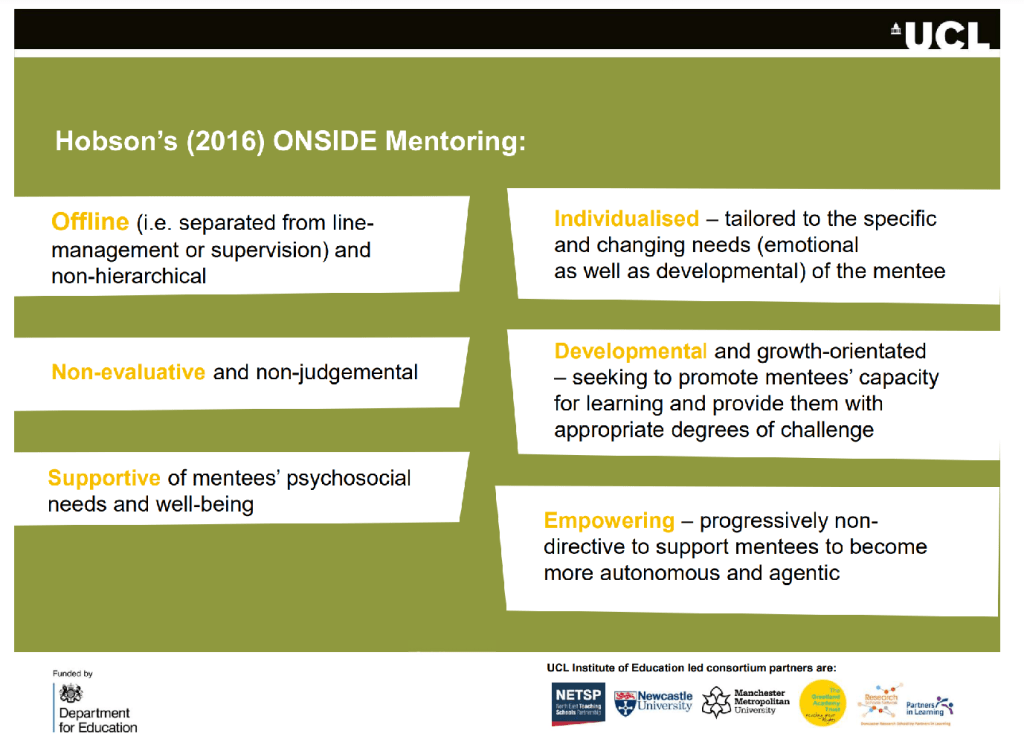
My mentoring strategy is to ask mentees ahead of time what the focus for each meeting should be, baring in mind the curriculum of modules that they were studying which I had been given. I was able to assist trainees with effective lesson planning for active learning, digital pedagogy and online learning and assessment strategies and positive behaviour management as well as writing and referencing academic assignments using appropriate literature sources.
Our meetings (held via Zoom) proved the ideal platform to explore effective online pedagogy for active learning such as use of problem-based learning and use of case study investigations. I was also able to demonstrate a variety of useful digital tools and strategies including Padlet curation, Mentimeter polls, GoConqr quizzes and use of webinar tools such as chat, breakout rooms and shared whiteboard spaces. The platform also proved useful for the three trainees to be able to rehearse their 20-minute online microteaching sessions in a safe space and get constructive feedback before facilitating the live, assessed session.
The University of Brighton also organised regular support webinars where all mentees actively working on programme were able to come together to discuss successful strategies, challenges and any concerns we had about curriculum or learner progress.
One mentee and I were asked by ETF to appear in a video promoting ONSIDE mentoring and Further Forces, to the sector seen here:
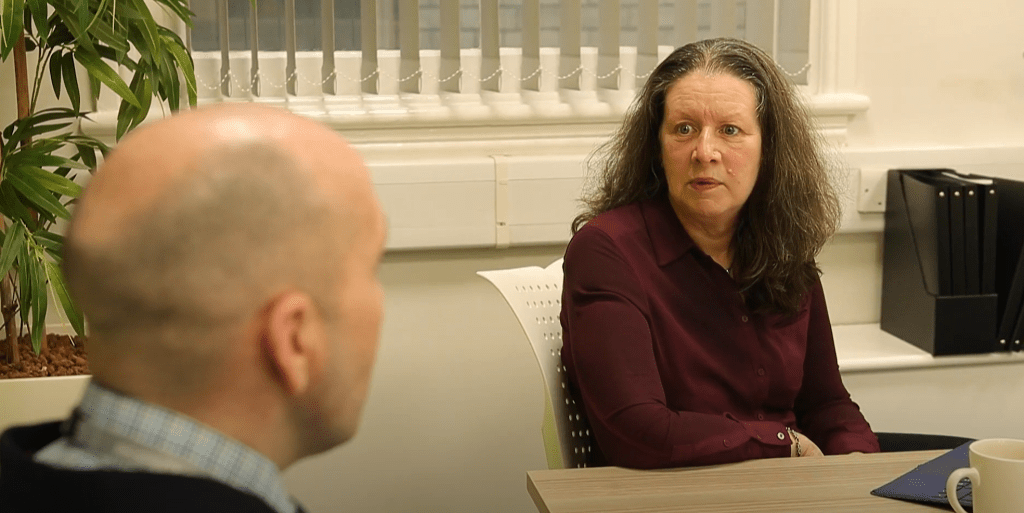
I was delighted and gratified that after 18 months of intensive study at a phenomenally challenging time for new teachers that all three mentees passed their ITE courses with flying colours and are now engaged in full time work in the sector.
My mentoring work in prison-based learning involved working with three teams working in the Midlands and the north. The teams were engaged in practitioner action research (McNiff, 2022) with the aim of encouraging prison-based educators to leverage learning technology more extensively and creatively in their practice to better prepare prisoners for the digital world on their release. This involved working with three projects:
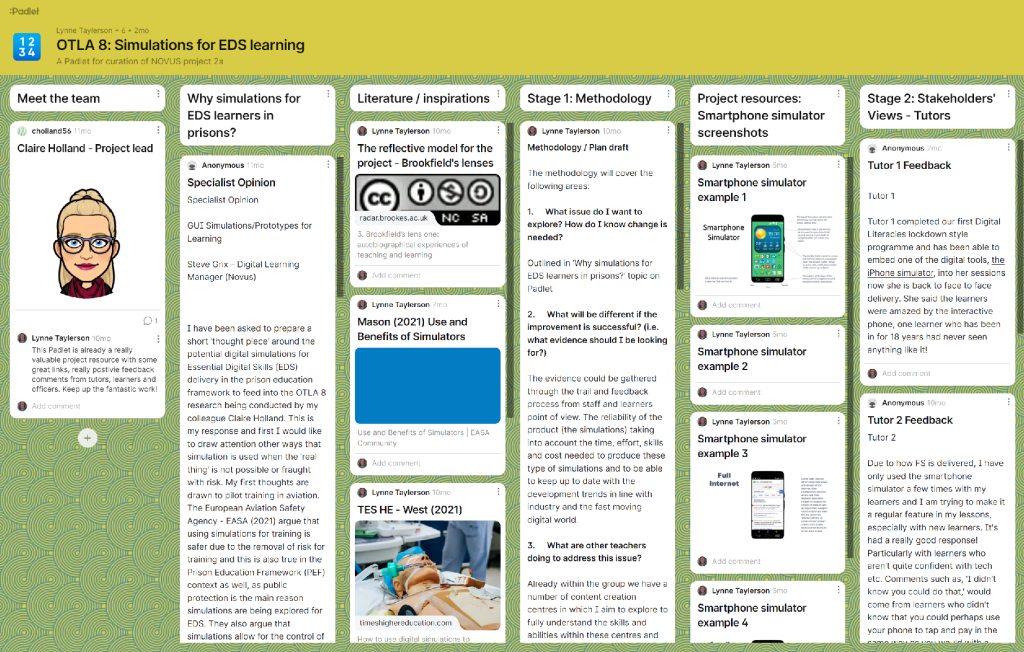
1. Creation of digital simulations to enable prisoners to gain realistic experiences with online systems they were not allowed access to in prison e.g. smartphones, email clients, online shopping systems and social media platforms:
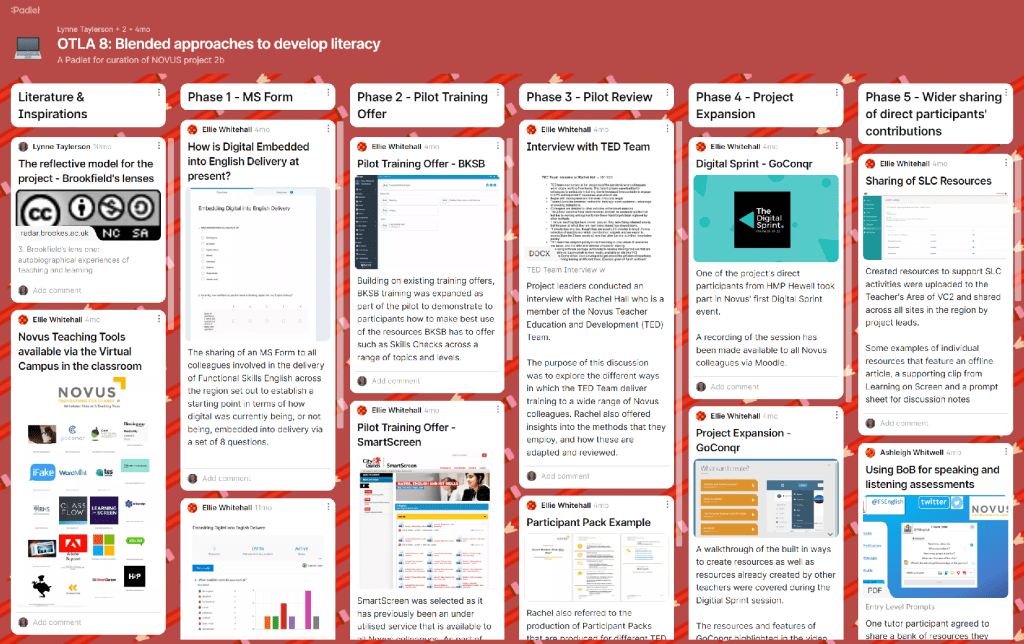
2. Encouraging prison-based English and digital literacy teams to use resources already available to offender learning teams more widely, for example the Virtual Campus and SmartScreen resources and videos:
The work of project team three built upon some work I had done for ETF in 2018-19 by creating the ‘Digital Skills Starter and Ender Cards‘ which were designed to spur discussions on digital tools and systems and simulate their use without the use of a computer:
3. Creation and piloting of a bank of paper-based, vocationally tailored activities for Construction, Hospitality and Cleaning learners to enable them to use interfaces and post content or purchase services on common digital platforms including Trip Advisor, Facebook, Instagram and online shopping websites:
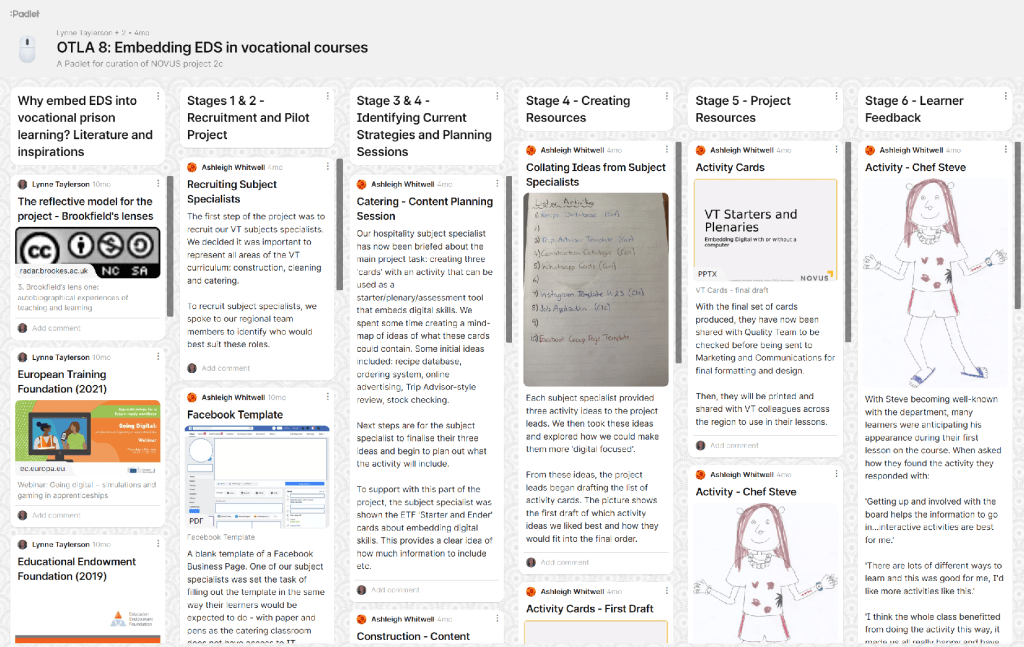
The 10-month work was conducted entirely during lockdown, which extended in prison learning for longer than much of the rest of FE. The partnership used MS Teams webinars for meetings (stipulated by the prisons as the only webinar platform staff can access), Box as a file sharing space (stipulated by the OTLA team) and Padlets for the curation of rich, multi-modal evidence (at my suggestion following its successful pilot with the Haringey Adult Learning Service (HALS) in mentoring work the previous year).
Work culminated in online final reports conveying outcomes, successes and challenges of the research and reflecting on the learning experience with digital tools.
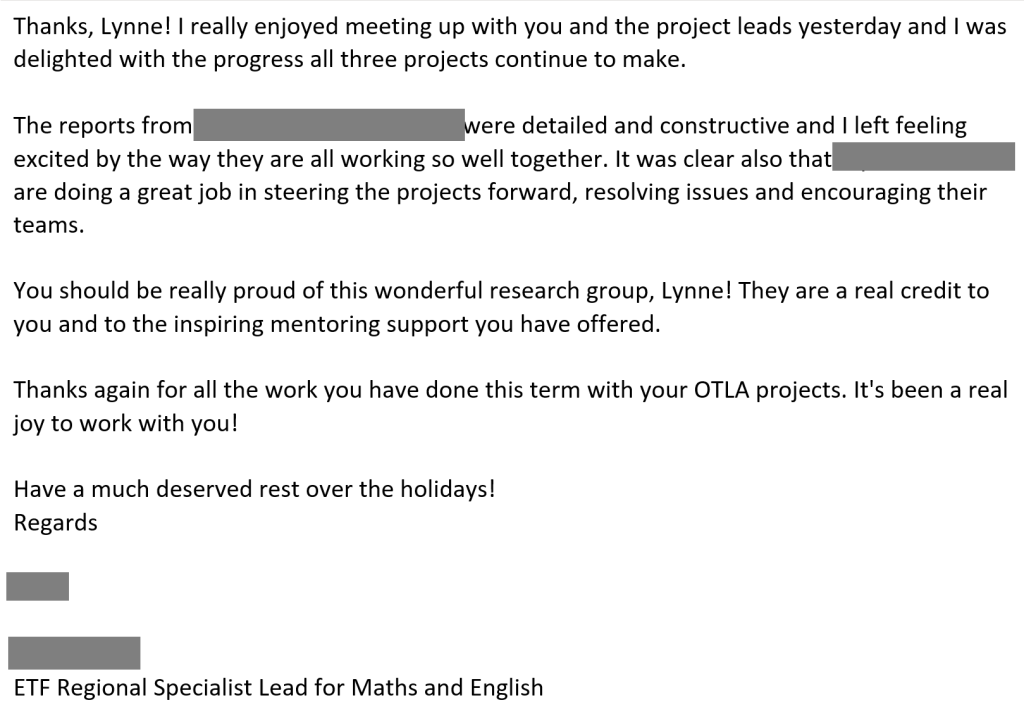
Here, I have included a testimonial on my mentoring practice and use of supporting technology from the ETF Regional Specialist Lead I was working with on the project:
Reflection:
I’m always honoured to be asked to mentor new or developing FE practitioners. It has always been my position that the mentor learns just as much as the mentee from a partnership – these partnerships were no exception. They were valuable in giving me insights into how a topic that I currently facilitated (Leadership and Management Studies) was delivered by a different organisation for an alternative Awarding Organisation and a window into the practices and challenges in an unfamiliar learning scenario (prison-based learning). In both cases, I was able to gain new insight into teachers’ challenges in developing digital pedagogy and tools and better understand what learners’ challenges were when accessing digital networks and developing digital skills.
For the mentoring relationship to work effectively I think it has to exist as a true partnership, free from organisational hierarchies where both partners operate in an ethos of mutual respect, learning from each other rather than as ‘observation of competence’ of the mentee by the mentor. The mentee should take the lead in deciding topics for discussion and action to build self-efficacy and independence in their practice. I believe Hobson’s (2016) ONSIDE framework provides excellent scaffolding for this ethos and it is one that I encourage all developing mentors to adopt.
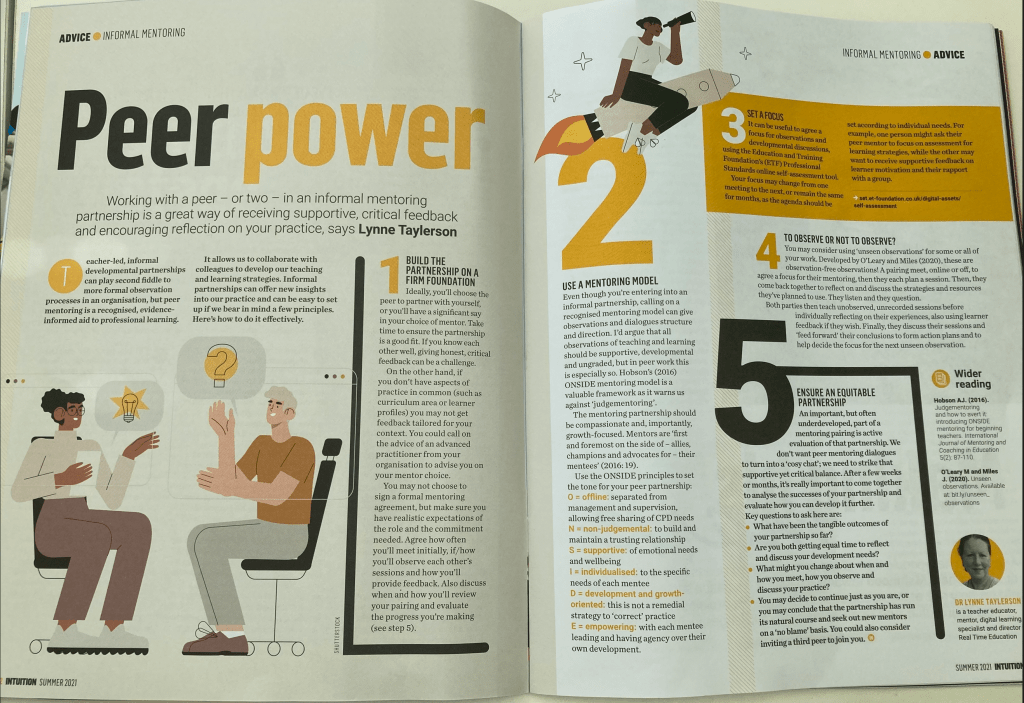
I authored an article for the Society of Education and Training’s (SET) inTuition journal in Summer 2021 following work with Further Forces and OTLA projects detailing how the ONSIDE mentoring philosophy might translate to a practical, organisational mentoring scenario:
The prison learning scenario in particular allowed me to work with a team in co-create engaging, realistic, paper-based templates for popular interfaces such as Facebook and Trip Advisor which gave learners as authentic as possible an experience in the absence of digital devices and Internet access. This reinforced my belief that with a little lateral thinking and creativity teachers are able to create valuable learning scenarios even with serious resource restrictions.
The affordances of digital technology were the only thing that made these mentoring partnerships feasible during lockdown. Beyond providing us with a discussion space the webinars allowed me to demonstrate a range of digital tools such as Padlet and GoConqr which I may not have had the opportunity to do in more a traditional, face-to-face mentoring setting.
I was particularly pleased with how the prison learning teams used Padlet boards so creatively for research curation. I had experimented with using the boards in the previous year but ran into difficulties. The OTLA teams found the ‘blank slate’ and huge range of options for Padlet designs and layouts overwhelming and were unsure where to start. I overcame this by providing scaffolding in the shape of pre-populated column headings matching the stages of the action research cycle and mirroring the sub-headings for the final report:
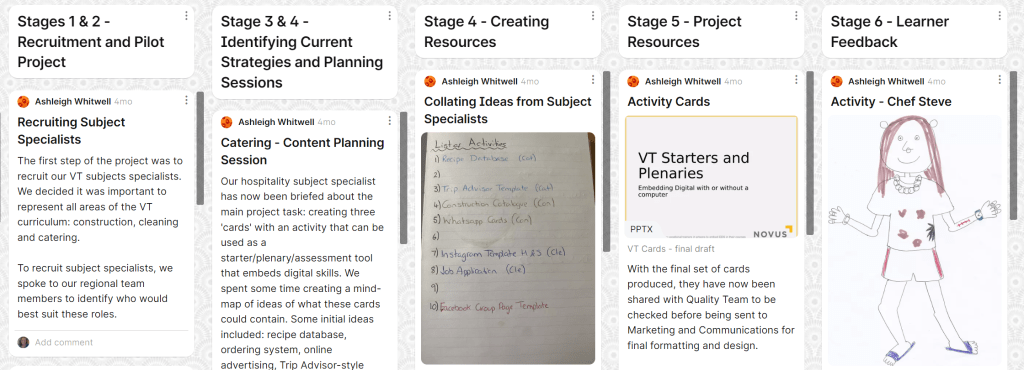
Teams then populated their curations chronologically, moving from left to right across the board, as the projects unfolded. They reported that they found it hugely beneficial to collect and curate artefacts (such as video interviews and photographs of digital resources) as they went along, making the final report compilation much easier.
The chief challenge with this project was that there remained significant resistance to using digital tools in some of the prison education team members. Some educators remained unwilling to invest the time and effort taken to overcome the challenges of getting digital tools set up for the first time in their learning spaces. I feel that a culture of ‘digital caution’ by some leaders and managers enabled and supported this resistance.
It is my hope that as more teams adopt and adapt more learning technology applications that the learner voice might be used to promote the popularity of these learning methods and that the successful case studies collected here might encourage reluctant educators to ‘give digital a go’ supported by their colleagues.
References:
Hobson, A.J. (2016) Judgementoring and how to avert it: Introducing ONSIDE Mentoring for beginning teachers. International Journal of Mentoring and Coaching in Education, Vol. 5 No. 2, pp. 87-110.
McNiff, J. (2022) Action Research for Professional Development.
[online] Available from: https://www.jeanmcniff.com/ar-booklet.asp. Accessed on 13/09/2022.
Return to SCMALT portfolio main page
 Lynne Taylerson SCMALT Portfolio